

Bathroom Vanity Ideas: What Works, What Doesn't, and What's Worth the Investment
7 min read
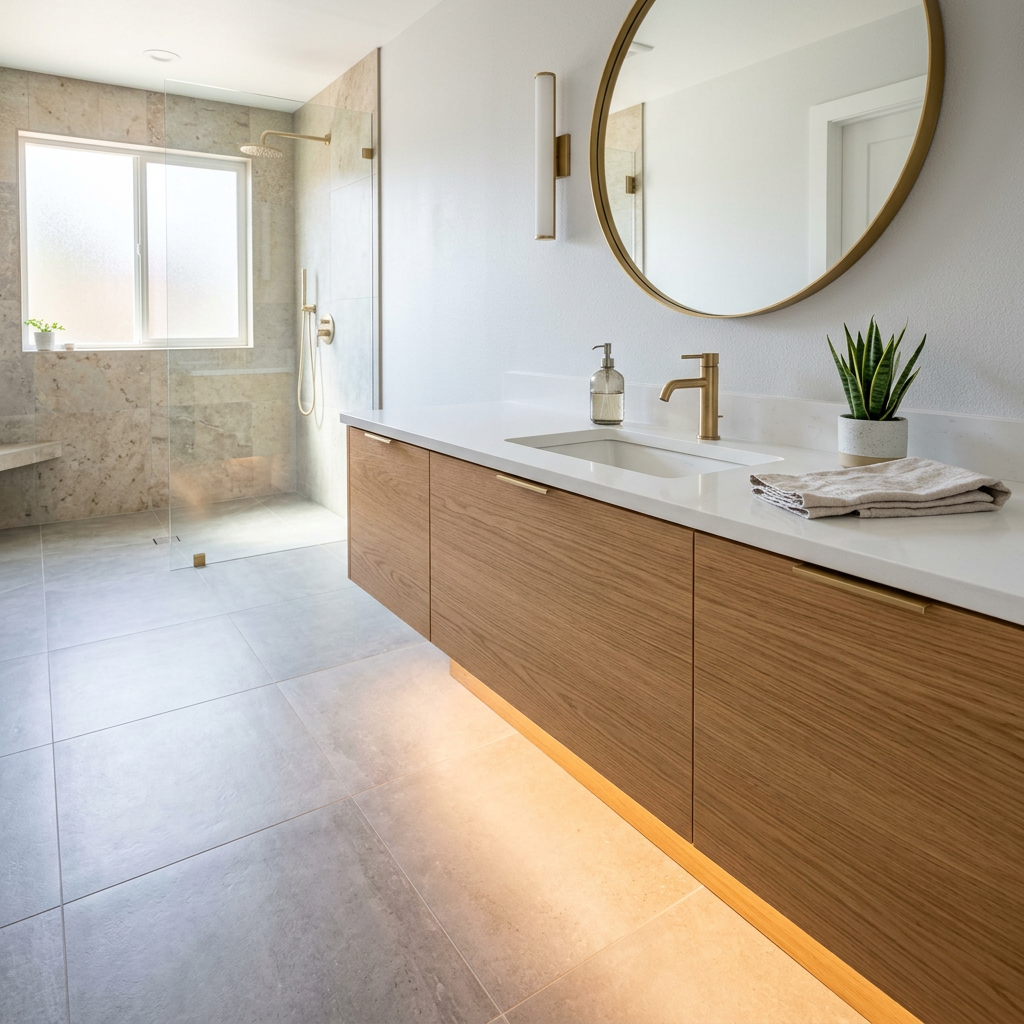
The bathroom vanity is the most-used surface in the house. It's where the day starts and ends, where the light either flatters or doesn't, where the storage works or it doesn't. It's also the element that more than any other determines whether a bathroom looks considered or assembled.
Most bathroom renovations spend the most money on tile and the least thought on the vanity — and then wonder why the finished room feels generic. At Interior Design Awards (IDA), the bathroom submissions that earn the strongest community votes almost always have a vanity that was clearly designed rather than selected from a catalog. Here's what those designers understand.
The first decision in any bathroom vanity project is structural: floor-mounted or floating. This choice determines how the room feels spatially more than any material or finish decision that follows.
A floating vanity — wall-mounted with clear floor space beneath — allows the eye to travel across the floor uninterrupted, making the room read as larger than it is. Combined with an LED strip underneath that washes light across the floor, the spatial effect is significant. In bathrooms under 6 square meters, a floating vanity is almost always the better choice.
A floor-mounted vanity provides more storage and feels more substantial — appropriate in larger bathrooms or master suites where the vanity is meant to read as furniture rather than a wall-mounted fixture. In a small bathroom, the same visual weight reads as filling rather than grounding.
The IDA community responds to this distinction clearly. Small bathroom submissions with floating vanities consistently score higher than equivalent spaces with floor-mounted cabinets — not because floating vanities are inherently better, but because they solve the space problem more intelligently.
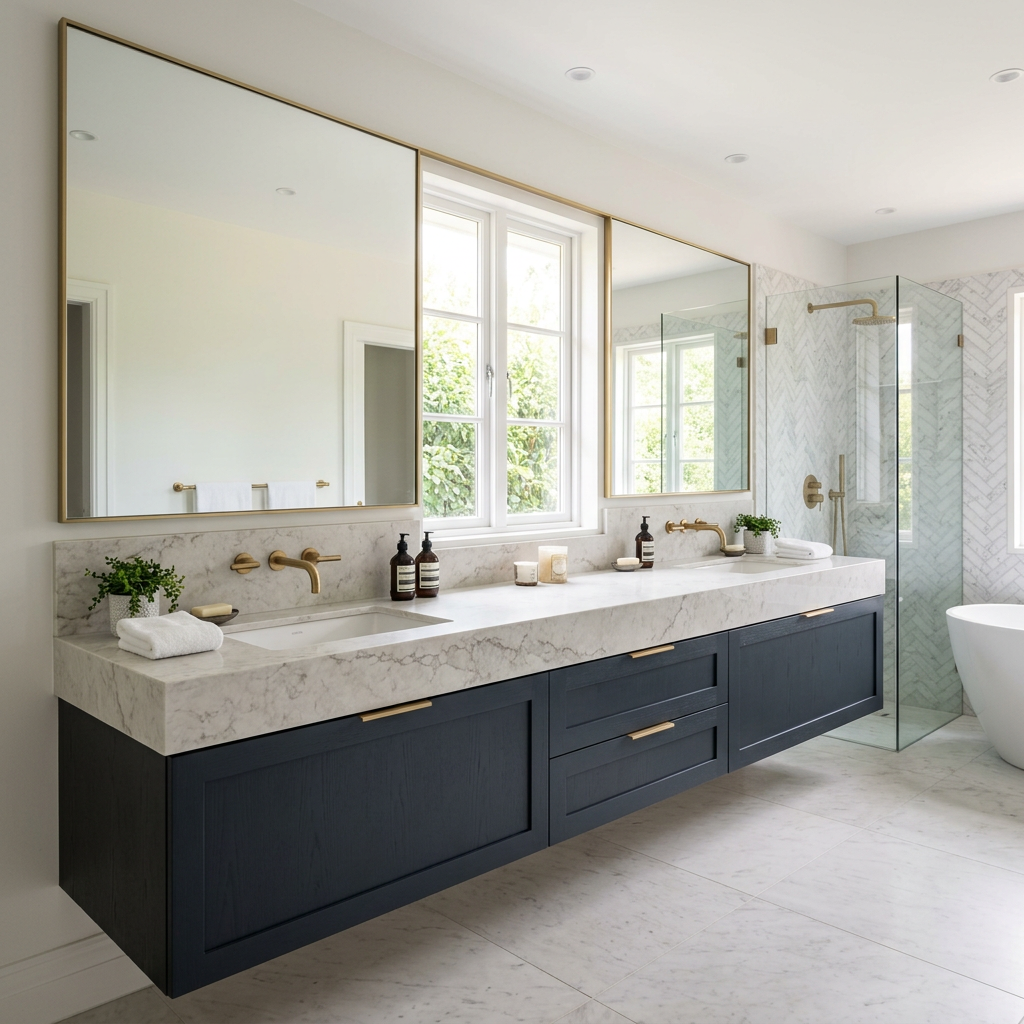
A double vanity is one of the most requested features in master bathroom design — and one of the most frequently executed in spaces that are too small for it to work.
The minimum requirement for a functional double vanity: 150cm of countertop width, with at least 60cm between basin centers. Below this, two people cannot use the vanity simultaneously without interfering with each other, and the entire point of having two basins is lost. Most double vanities installed in bathrooms under 200cm wide create the appearance of luxury without the function.
When the space is right — a master bathroom with 180cm or more of available vanity wall — a double vanity in a continuous countertop material, with matching fixtures above each basin and a wide mirror or two individual mirrors, is one of the most architecturally satisfying elements in residential design. Symmetry, repetition, and clear function working together.
The countertop is where the investment pays off most visibly at this scale. A 180cm slab of bookmatched stone, with both basins undermounted, reads as genuinely luxurious. The same width in a prefabricated vanity top looks like a large version of a small bathroom fixture.
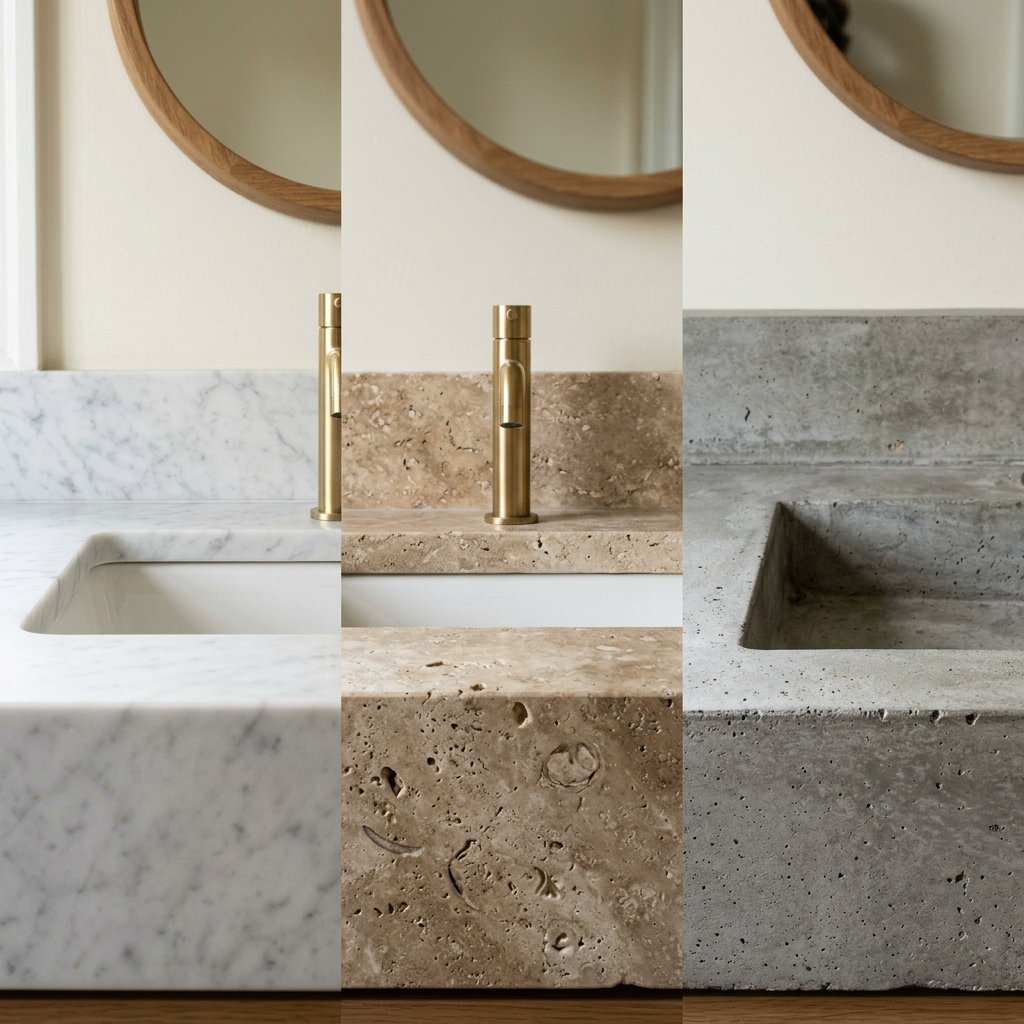
The vanity countertop is the surface you touch every day, the one that takes water and toothpaste and everything else, and the one that more than any other material defines the character of the room. Choosing it correctly requires understanding what each material actually delivers — not just how it looks in a showroom.
Natural marble is the aspirational choice — beautiful veining, cool touch, genuinely luxurious. The reality: marble requires sealing and some maintenance, and it will develop a patina over time that some people find characterful and others find problematic. Honed marble (matte finish) handles daily use better than polished and looks less formal.
Travertine is warmer and more forgiving than marble, with natural fossil inclusions that give it genuine character. Its surface variation means minor marks disappear rather than standing out. It seals easily and ages beautifully.
Concrete offers a completely different quality — raw, industrial, with an integral basin option that eliminates the seam entirely. It's heavy, requires professional installation, and develops a unique patina. In the right room it's exceptional; in the wrong room it's just grey.
Quartz and engineered stone are the practical alternatives: consistent appearance, no maintenance, wide color range. They look good but lack the sensory quality of natural stone. In bathrooms where the vanity is one of many design elements, they're an appropriate choice. In bathrooms where the vanity is the centerpiece, natural stone pays for itself in atmosphere.
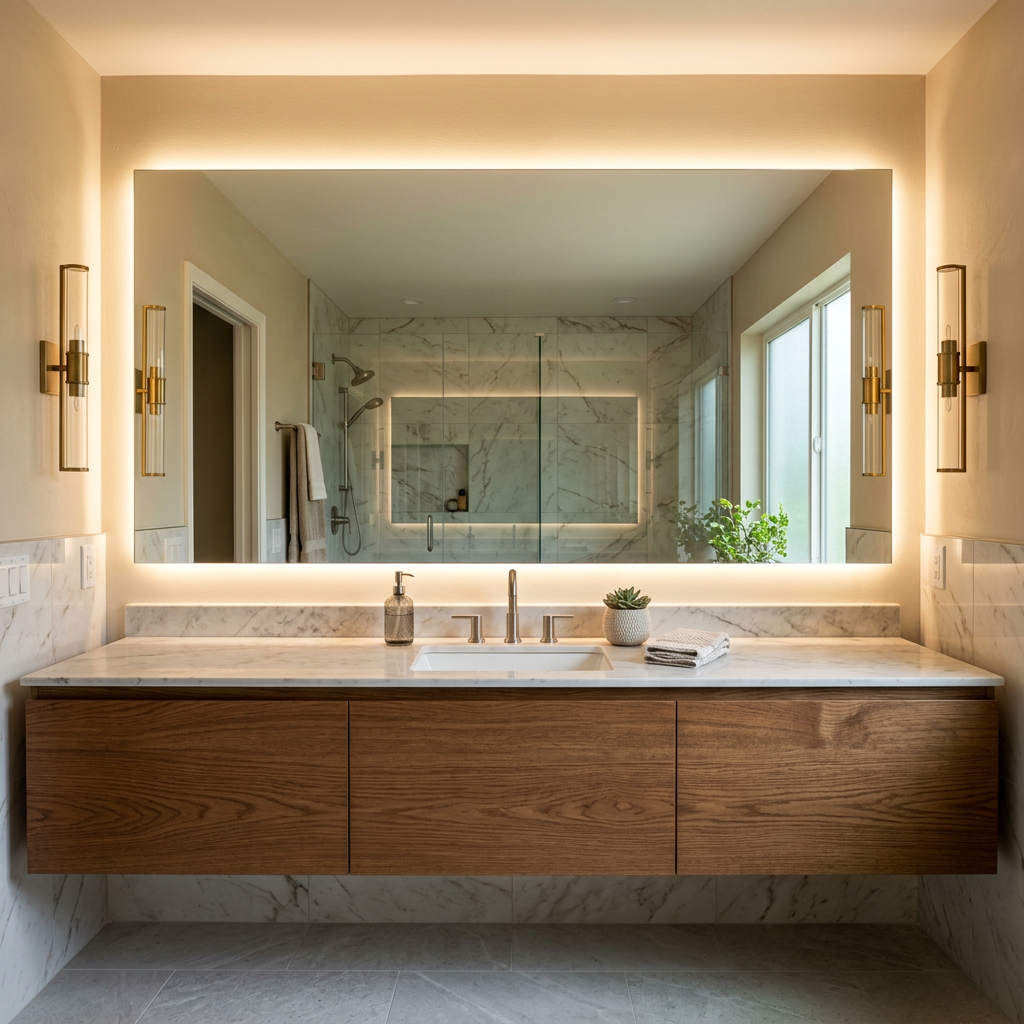
The mirror is the most underestimated element in bathroom vanity design. Most people treat it as a functional accessory — something to look at yourself in — rather than as a design decision with major implications for light and space.
A mirror that spans the full width of the vanity wall, rather than matching only the width of the basin or cabinet, doubles the perceived depth of the room by reflecting the opposite wall. A mirror that extends from countertop height to ceiling doubles the perceived height. These are not subtle effects — they're the difference between a bathroom that feels generous and one that feels constrained.
Lighting at the mirror matters as much as the mirror itself. The worst vanity lighting is a single fixture above the mirror — it casts downward shadows on the face and makes the room feel clinical. The best vanity lighting is at face height on either side of the mirror, which illuminates evenly from the sides and eliminates shadows entirely. An illuminated mirror with integrated LED around the perimeter achieves both ambient light and practical mirror light in one element.
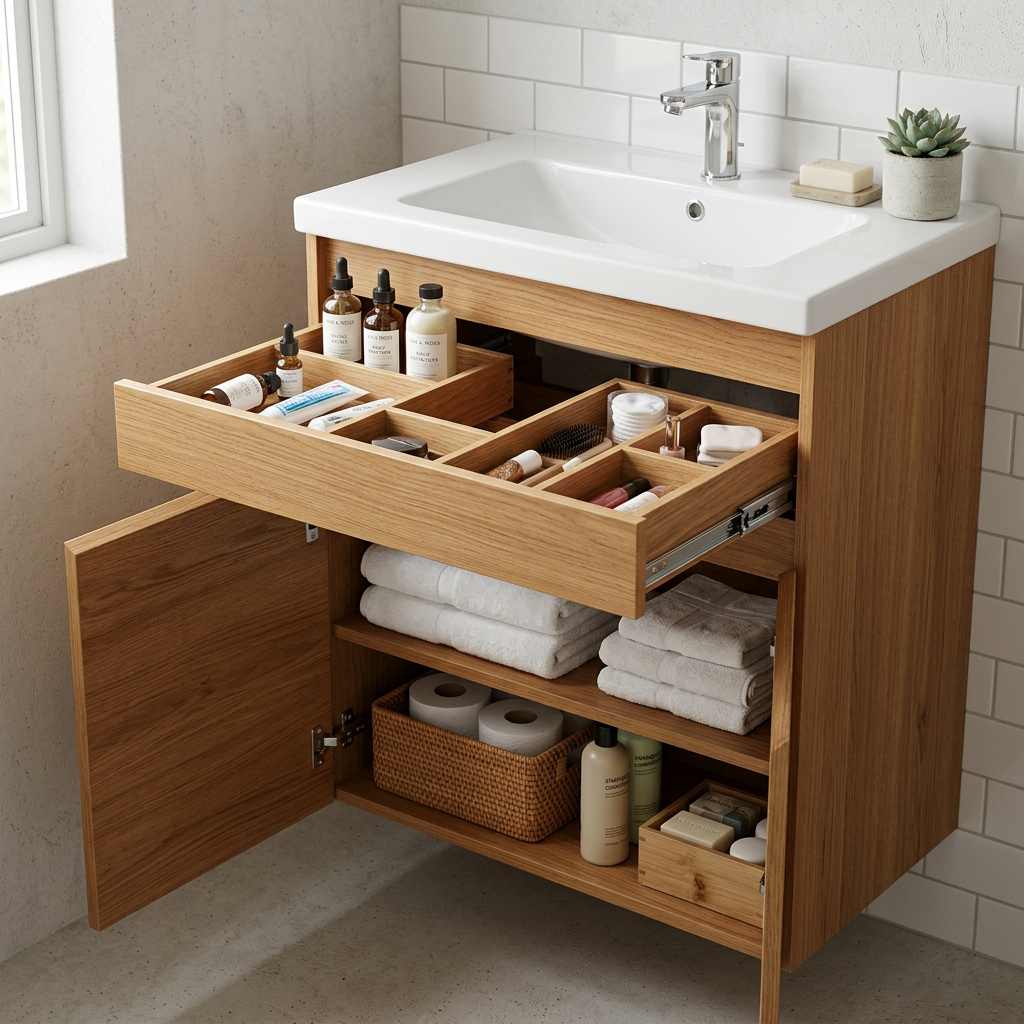
A bathroom vanity that looks beautiful but doesn't store things well fails every day. The storage configuration is the element most people discover is wrong after installation — and the one that's hardest to change.
The most functional vanity storage prioritizes drawers over doors and shelves. Drawers allow full visibility and access to everything stored — nothing gets pushed to the back and forgotten. Deep drawers (20-25cm depth) accommodate hair dryers, straighteners, and large bottles. Shallow top drawers with internal organizers handle small daily items. This configuration, three drawers on each side of an under-sink cabinet, handles the storage needs of most bathrooms without requiring additional furniture.
Open shelving below a floating vanity — a common design choice for aesthetic reasons — requires discipline to maintain. Rolled towels and a few ceramic objects look good in photographs; the accumulated reality of daily bathroom storage usually doesn't. Unless there's commitment to keeping open shelving genuinely edited, closed storage is the more functional choice.
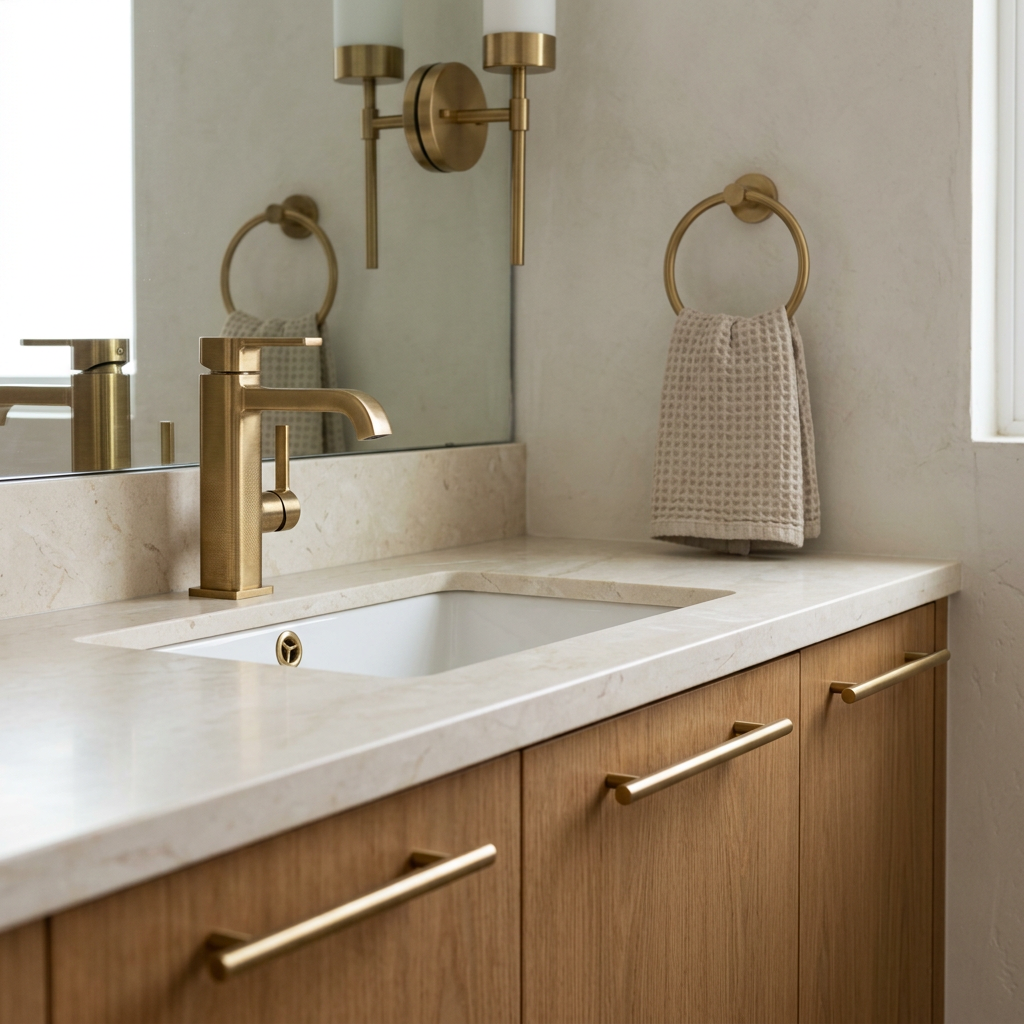
Hardware is the last decision in a vanity project and the one that determines whether the finished result feels resolved or not. In a room as visually contained as a bathroom, mismatched hardware finishes — chrome faucet, brushed nickel pulls, old brass towel ring — create low-level visual noise that undermines the quality of everything else.
The solution is simple: pick one finish and use it for every metal element in the bathroom without exception. Faucet, drawer pulls, towel bar, robe hook, toilet paper holder, mirror frame or sconce arms, shower fixtures. One finish, consistently applied.
The three finishes that work best in current bathroom design: matte black (works with warm whites, natural wood, concrete), brushed gold or brass (works with cream, warm stone, warm wood), brushed nickel (works with cool grays, white marble, white tile). Each has a character — matte black reads as contemporary and graphic, brushed gold as warm and refined, brushed nickel as cool and precise.
IDA bathroom submissions that earn the highest community votes consistently demonstrate this hardware discipline. It's a small decision that has a disproportionate impact on how considered the finished room appears.
A bathroom vanity that works solves three problems simultaneously: it makes the room feel the right size, it lights the face correctly, and it stores things in a way that works every day. A vanity that only solves the visual problem — that looks beautiful in a photograph — fails the other two tests daily.
The IDA community, which includes working designers and experienced homeowners, recognizes the difference immediately. The most-voted bathroom vanity submissions are the ones where the spatial decision, the light, the material, and the storage all serve the room's actual function — not just its appearance.
Every month, designers submit their best bathroom projects on Interior Design Awards. The community votes, and the top 3 earn recognition and cash rewards.
→ Browse this month's bathroom submissions
→ Submit your bathroom design and compete
Interior Design Awards (IDA) is a platform where designers share room projects, the community votes monthly, and the top designers earn recognition and rewards. Based in the US, open to designers worldwide.